
Copper Ecology Explained: The Roles, Imbalances, symptoms & Emotional Meaning of Copper in the Body
A look at the venusian mineral of Fertility, emotionality and how it affects hormones, mood and feminine health.

What Copper Does in the Body
First I want to acknowledge and thank my teachers on this topic Niecia Nelson, Sarah Gensmer and Dr. Robert Selig for their in-depth offering of wisdom on the nuances of Copper. It is what allowed me to hold an ever-evolving understanding of Copper in the body and has deeply informed this post here today.
There is a common mythos swirling around in the pro-metabolic community that vast majority of people are Copper Toxic.
My issue with this conversation is that the common layperson is not versed in the relationship and biological function of Cellular Minerals, nor the complex and nuanced relationship Copper has in the ecosystem of the body. I want to address Copper with a deeper understanding of its primary biological, emotional, and psychological functions, as well as it’s mythology and profound impact upon our lives.
Let’s get right in..
Copper is a Trace Element. Trace Elements are essential for the vital function of living systems ( humans!). In Hair Tissue Mineral Analysis and Mineral Balancing we look at the ratios of our body’s essential minerals as they are in relationship to each other and the larger ecosystem. We test the hair for these minerals for specific reasons, rather than blood which is a tightly regulated system always maintaining homeostasis. ( read more on Why We Test Hair Not Blood here)
Copper is needed in the following roles in the human body:
Mental Health + Neurotransmitter Synthesis/ Metabolism
Enzyme + Co-factor Function
Antioxidants + Redox Balance (Copper's ability to readily accept and donate electrons)
Structural Integrity of Collagen, Connective Tissue and Fascia
Healthy Iron levels through Iron Recycling + Cerruloplasmin
Women’s Health + Hormonal Balance
But outside of these biological functions, Copper is deeply impacting our ability to Receive.
Copper is a deeply feminine element, ruled by Venus, the planet of Love, Relationships, Pleasure, Beauty, Connection. Copper plays a role in the psyche of a woman through these Venusian themes. Copper gives our body it’s youthful glow, it’s what radiates beauty through us when we are nourished and cared for, when our hearts are well tended and our body’s well-loved. Copper brings sensuality and pleasure, stokes our libido, opens our field to receive and be penetrated by life. Copper is a creative channel, a vessel both electrically and energetically in the body and feminine field.

Copper’s Relationship with Estrogen & Emotions
Copper is intricately and beautifully entangled with Estrogen. It is actually consider a Metalloestrogen (it mimics natural estrogen by binding to estrogen receptors when free and unbound in the body.) Copper will do the job of Estrogen when uncoupled in the body and take up her role often, exacerbating Estrogen Dominance through issues like:
PMDD
Endometriosis
Progesterone deficiency
Breast cancer
Depression
Postpartum mood issues
Mental health challenges such as Mania, Volatility, Anger
Gestational diabetes
Dysmenorrhea (painful periods)
Amenorrhea (absence of periods)
Uterine fibroids
Ovarian cysts
Yeast infections
Endometriosis
Miscarriages
Morning sickness
Toxemia of pregnancy (preeclampsia)
Estrogen raises Copper absorption
Copper raises Estrogen levels
Copper opens us up in Venusian Receptivity
Estrogen increases our readiness to receieve
When Copper & Estrogen is in harmony and balance, there is a movement towards desire, connection and social bonding. Our desire for union increases, the cervix- doorway to worlds- opens, the tissues of our feminine body soften to help with emotional and physical reception. Copper and Estrogen is what makes us deeply feminine creatures.
Copper and Zinc : Mineral Interactions
Copper and Zinc have an important relationship together in they compete together for binding sites in the body. They have an antagonistic relationship in the following ways:
Competition for Absorption: Zinc and copper compete for binding sites in the gut, so high intake of one can block the absorption of the other.
Metallothionein: Zinc stimulates the production of metallothionein, a protein that strongly binds both zinc and copper, making copper unavailable for use in the body
Maintaining Equilibrium: While antagonists, they are vital partners, and maintaining a proper copper-to-zinc ratio is more important than individual levels alone.
Correcting Imbalances: If copper levels are too high, increasing zinc can help bring them back into balance, and vice versa.
In HTMA and Mineral Balancing, we look at the Ratio of Minerals- the way they are in relationship together. The Zn/Cu Ratio is an important one to look at when getting curious about Copper.
Both Zinc and Copper have a large impact on the modulation of neurotransmission, which in turn affect our mood, hormones, and overall well being.
Copper is correlated with Estrogen
Zinc is connected with Progesterone.
Zinc’s Effects are
Inhibitory: Enhances GABA (calming), influencing mood and relaxation.
Excitatory Modulation: Can inhibit some excitatory signals but potentiate others.
Neurotransmitter Synthesis: Involved in producing dopamine, norepinephrine, and serotonin.
Neuroprotection: Helps maintain neuronal structure (microtubules) and can be neuroprotective.
Copper’s Effects are
Excitatory: Often increases neural excitability, potentially overstimulating neurons.
Neurotransmitter Synthesis: Vital for enzymes that create dopamine and norepinephrine.
Neurotoxicity: Excess copper can collaborate with zinc to cause oxidative stress and neuronal death, especially after ischemia.
Both of these minerals play a big role in fertility, immune system, mood, hormones and the reproductive system on a whole.
What does it feel like in the body?
In Balance we feel: Radiant, alive, receptive, open to connection, open to possibility, soft, desirous, sensual, budding
When Imbalanced we feel: Overwhelmed, sensorially flooded, emotionally fragile, hormone disruption ( especially prominent in Follicular/Luteal Phase), Manic or prone to quick temper
Women have a harder time mobilizing copper with age, as our relationship to Copper changes through our life and infradian (menstrual) cycle.
So what IS Copper Toxicity?
Copper Toxicity is Copper pushed beyond it’s metabolic pathways during overload. When it is pushed beyond these pathways, it will bind to pother proteins and cause structural / biological changes( ex: mental health / hormonal health shifts with estrogen ). If Copper leaves the workflow within our natural harmonic ecosystem, our body as the highly intelligent creation it is will sequester ( hide it ) it to prevent damage, primarily in the Liver, Brain, Muscles/ Connective Tissue and Kidneys.
There are two forms Copper can be found in within the body.
Cu 2+ ( the stable form) and Cu 1+ ( the easily oxidized form which can stress that damages lipids, proteins, and DNA)
Here’s how Copper is assimilated in the body:
Copper enters through food and water into the small intestine where it binds with proteins like Cerruloplasmin ( a liver-produced protein that carries copper throughout the body, essential for functions like energy, bone health, melanin production, and iron regulation, while also acting as an antioxidant) in the liver, then it enters the bloodstream. Glutathione + antioxidants scavenge free copper ( unbound) back to the bile for excretion.
70-90% of our body’s Copper is loaded onto Ceruloplasmin, which is crucial for Iron Metabolism and the conversion of different forms of Iron in the body. So, Copper plays a crucial role in the recycling of Iron.
The Copper Paradox
We can be both deficient in bio-available copper (copper in a usable form) and toxic in usable Copper at the same time. Having enough Cerulloplasmin is a big factor in preventing Copper Toxicity.
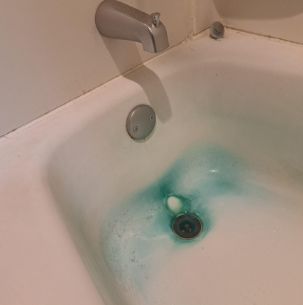
Picture from Reddit of a bathtub showing turquoise stains from Copper pipe corrosion- affecting the water supply.
Copper Toxicity is most commonly coming from an external source, not food.
There is a stark difference in the way the body processes Copper from an environmental source ( like Copper Pipes or Birth Control ) and Copper in Beef Liver, Oysters, Pumpkin seeds and Dark Chocolate. *Your body is primarily absorbing dietary copper through the small intestine for essential functions, while environmental sources like pipes or IUDs often release ionic copper that can be absorbed more readily in the gut or cause localized irritation, with the liver carefully regulating overall copper levels through biliary excretion to prevent toxicity from any source.
A key question then becomes :
What kind of Copper Pattern is present?
Is copper bio-unavailable or hidden in the tissues, or is it truly elevated and active due to an environmental exposure? This question often leads to other questions too, like “ What is the Theme of Copper in my life right now?”. As a woman I know says “ sometimes the medicine is in the question more than the answer.”
And sometimes the answer comes from long-term HTMA testing to track what happens with Copper as the first four Mother Minerals (Calcium, Magnesium, Sodium and Potassium) shift with tending. Sometimes, we might not find the answer at all. Much of our Minerality is Mystery and may remain so to us. Can we be open to not having all the answers?
This Copper can be liberated but it must be done so carefully, tactfully and gently so as to not overload the body with oxidative stress with a dumping of Copper.
Forcing metals or minerals out of a body that is already taxed, stressed and under-resourced is a sure-fire way to make matters worse. It’s like ripping a security blanket out of the hands of a toddler who is struggling to calm down already. It’s a major stress on the body that it does not have the resources to manage already ( or it would let go of the heavy metals / excess copper on it’s own accord).
So, How do we start exploring our relationship with Copper?
A Hair Tissue Mineral Analysis test is a great place to start. We can track our symptoms and get curious about environmental exposures to Copper, but ultimately it’s helpful to have a look at what’s really showing up.
One important distinction is Blood versus HTMA. Blood Copper reflects what is circulating in the moment and is very tightly regulated by the body, so it can appear normal even when copper is stored, dysregulated, or bio unavailable at the tissue level. HTMA looks at longer term mineral patterns, bio availability, and stress physiology, which is why many practitioners find it helpful when exploring Copper imbalances. Blood tests are helpful for determining Ceruloplasmin levels which is what Copper binds with, so they can both be complimentary if you know what you are looking to measure on each test.
If blood tests are normal but symptoms persist, HTMA offers deeper insight into underlying mineral imbalances and nutrient interplay.
HTMA reads the story of your metabolic blueprint through your hair- how your cells are functioning, where minerals may be out of balance, and how your body's patterns are weaving themselves together.
Mineral Balancing is the process of gently guiding you with nourishment, rhythm and practical skills.
For many women + families, HTMA is the Missing Piece in their healing journey when they have seemingly done everything and nothing touches the core of their challenges.
Mineral Balancing work is slow drip.
This is purposeful and good. It’s what allows the work to be sustainable and also safe. HTMA invites us to explore the body as a living ecosystem. Revealing how our inner patterns and emotional landscapes intertwine.
Your hair holds the story of your metabolism, minerals, and stress resilience.
Hair Tissue Mineral Analysis ( HTMA ) is a gentle, non-invasive, evidence-based test that reveals how your body is adapting to life's demands- physically, emotionally, and energetically.
Discover where your body's minerals are out of balance1
Understand your stress response patterns
Identify hidden blocks to energy, sleep, and mood
Learn how to restore Nourishment, safety, and vitality.
It asks us to gently reckon with our internal narratives, reclaiming the parts of ourselves that have been overlooked. In this way, mineral balancing becomes a pathway to profound healing, guiding us back to a state of calm, present living, and deeper self-awareness.
This work takes time, and it's so worth it.
But what awaits you on the other side is a life that feels slow-drip, even in the stressful moments… Time slows down, you’re receiving each moment as a gift to be fed by and you begin to know what it feels like to thrive, not just survive…
I believe that we cannot be nourished by food if we are not inhabiting our bodies. I address minerals as a bridge between the physical, psychological, spiritual dimensions of existence.
Curious to Learn more? Check out my HTMA Sessions here
Citations
Copper’s Role in Premenstrual Disorders
https://pmc.ncbi.nlm.nih.gov/articles/PMC12647176/#:~:text=)%20%5B18%5D.-,Zinc%20(Zn)%2C%20copper%20(Cu)%2C%20and%20magnesium,Mg%20supplementation%20on%20PMD%20symptoms.
How The Body uses Copper in Food vs Environmental Forms
https://pmc.ncbi.nlm.nih.gov/articles/PMC4339675/#:~:text=Essentially%20all%20of%20the%20body's,Cu%20metabolism%20and%20other%20factors.
Copper & Zinc’s Role in Neuroexcitability
https://pmc.ncbi.nlm.nih.gov/articles/PMC11274390/#:~:text=Cu%20reportedly%20enhances%20neural%20excitability,+%5Di%20rise%20is%20needed.
Interaction between copper and zinc at GABAA receptors
https://www.psychiatryredefined.org/the-important-role-of-copper-and-zinc-in-children-with-adhd/#:~:text=The%20Problem%20With%20Too%20Much,I%20was%20writing%20this%20book.
https://pmc.ncbi.nlm.nih.gov/articles/PMC1572144/#:~:text=Synaptically%20released%20Zn2+%20may,of%20zinc%20in%20Wilson's%20disease.
**Disclaimer:
This information on this page and website is for educational purposes only.
HTMA + Mineral Balancing are offered for informational purposes and are not medical diagnostics or treatments. By viewing the information on this page you understand that we are not offering licensed medical care, treatment, prevention or diagnosis of any illness or disease. Ancestral Mother and Jillian MacKenzie Talbot are not responsible for the outcomes or choices of action you make regarding your Hair Tissue Mineral Analysis Test and Report. This is not a clinical diagnostic tool. Please consult your healthcare provider for medical guidance.
